

Every aid station of the Dirfys Trail Run has a name and a story. Each one is dedicated to people who loved the mountain, to those who lost their lives protecting it, and to friends who stand by us every year. When you reach a station, along with water and food, you will find a piece of this land’s memory. Here you can read who they are.
K. Karakitsios – D. Kostopoulos
HERAIOS ATHLOS CP1 – 4.2 km
DIRFYS PATHS CP1 – 4.2 km
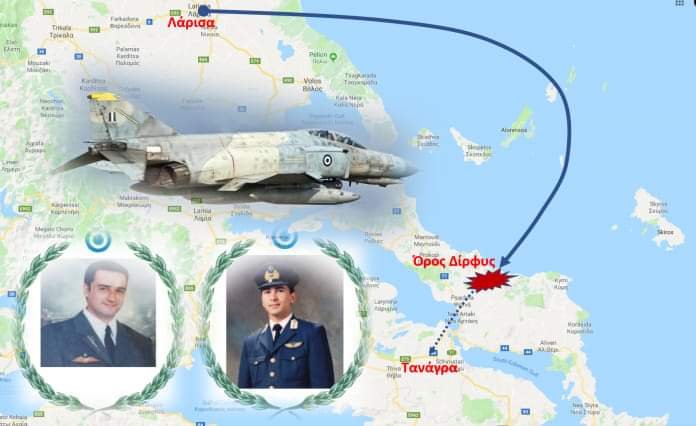
The first aid station of the 15 km and 30 km races is dedicated to two young Hellenic Air Force officers who lost their lives on the highest peak of Evia in 2002.
The terrible sound of the Phantom crashing was heard across the Northern Sporades early on the morning of 26 June 2002, shortly after take-off. It shook the local community and the whole of Greece, which mourned the loss of two young airmen.
The two fallen pilots
Two experienced airmen and young men lost their lives in the accident: Flight Lieutenant Kyriakos Karakitsios, 31, from Kozani, and Flying Officer Dimitris Kostopoulos, 29, from Larissa.
Th. Anastasiadis
KATZOS PATHS CP1 – 1.1 km

The first aid station of the 5 km race bears the name of Thanasis Anastasiadis.
Thanasis was a man who loved the mountains, which gave him joy and strength.
In his last years he focused more on climbing, and he gave a great deal of help to the Chalkida mountaineering club.
He loved sharing his knowledge and his help with young mountaineers. That is what he was doing on his last climb, on Mount Olympus. He left us in the place he loved so much.
We will always miss him.
Sevach
HERAIOS ATHLOS CP2 – 5.8 km
DIRFYS PATHS CP2 – 5.8 km
After our friend Sevach was poisoned by poison bait near the refuge of the Chalkida Mountaineering Club (EOS Chalkidas), we decided to dedicate the second aid station of the 15 km and 30 km races to him.
So at the 2nd aid station (5.8 km), at the EOS Chalkidas refuge, his friends will be waiting for you.
In the video below, Giorgos shares a few words from the heart about his friend Sevach (in Greek).
Sideritis
HERAIOS ATHLOS CP3 – 8.7 km / CP6 – 26.6 km
DIRFYS PATHS CP3 – 8.7 km

“Sideritis”, the Association for the Protection of Nature and Cultural Heritage, staffs the third aid station of the 15 km and 30 km races, as well as the sixth station of the 30 km.
It is a fairly young association, officially founded in 2019. Its work covers the protection of nature and cultural heritage, environmental education, recording local fauna and flora, organising related events, outings into nature and to places of cultural interest, solidarity initiatives and more.
The association already takes part in environmental protection projects in Evia and beyond. It also works to highlight and protect monuments of cultural heritage.
It also organises the “Sokratis” mountain race.
You can find more information on the association’s website, www.sideritis.eu.
Antonis Sykaris
HERAIOS ATHLOS CP4 – 14.5 km

In April 2022, just one day after the joy of reaching the summit of Dhaulagiri (8,167 m), Antonis Sykaris, one of Greece’s finest mountaineers, lost his life. He had dedicated the summit to Nikos Papandreou and his family, to Babis Tsoupras and his family, to Ermis-Theofanis Theocharopoulos and his family, and to all Greeks, all mountaineers and his little granddaughter Irida. The short announcement read: “at an altitude of 7,400 m, very close to Camp 3, at 4:00 in the morning Nepal time, after a huge physical and mental effort and without supplementary oxygen, he breathed his last on the mountain.”
Within a single day, all our wishes for a safe descent turned into mourning and deep sorrow.
Antonis left us chasing his lofty goal and the highest peaks in the world. He left doing something he loved, something high, something out of reach. He will always be in our hearts and minds as a shining example and an inspiration to pursue high goals with the tireless effort they demand.
The day before, Antonis had sent us his joy and his dedications, and made us all proud:
“Today, 11 April 2022, at 12:50 Nepal time, I am on the summit of Dhaulagiri, 8,167 metres.
I want to dedicate this summit:
To Nikos Papandreou and his family.
To Babis Tsoupras and his family.
And to Ermis-Theofanis Theocharopoulos.
I also want to dedicate this summit to all Greeks, to all mountaineers and to my little Irida, my granddaughter. Irida, my love, I’m on the top!!!
Grandpa is on the summit!!!
Thank you to all my friends and to everyone who supported me and helped me reach the summit through social media!
I made it thanks to you!!!
I love you all!!!”
And we all love you, Antonis, and wish you peace up there in the heights! Our deepest condolences to your wonderful family.
Who was Antonis Sykaris
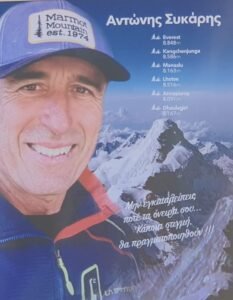
Born in May 1962, Sykaris was one of the most successful and experienced Greek mountaineers, and the only Greek to have climbed 5 of the 14 “eight-thousanders”, the peaks of the ultimate mountaineering Grand Slam, Everest among them.
He had 32 years of experience in mountaineering and climbing, 66 expeditions around the world and 615 mountaineering and climbing routes in Greece and abroad.
He was married to Kalliopi Koni. They had a daughter and a son, Violeta and Giannis, and a granddaughter, Irida.
As he told the Greek magazine “Taxidia” in 2018: “What frightens me most is the risk of freezing and being left helpless, as has happened to many climbers on Everest in recent years. Or, at best, losing a few fingers or your nose to frostbite.” This is a passage from the “black box” of Antonis Sykaris, the diary he kept on his iPhone during his 2017 Everest expedition.
By 2018, Antonis Sykaris already had three of the 14 mountains of the mountaineering “Grand Slam” on his climbing record: the sacred “pyramid” of the planet’s highest summits, all above 8,000 metres. After 27 years of climbing lower, and perhaps more technical and difficult, mountains, in 2017 he achieved his dream of standing on the top of the world, on Everest (8,848 m), roped together with Mike Evmorfidis. Kangchenjunga (8,586 m) with Fotis Theocharis and Manaslu (8,163 m) with Giorgos Marinos followed.
Source (in Greek): medlabgr.blogspot.com
The five heroes of Mistros
HERAIOS ATHLOS CP5 – 23.4 km
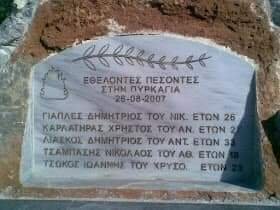
Dedicated to the five heroes of Mistros.
In August 2007 these young men died defending the forest, which was their home and their livelihood. Once upon a time there was a beautiful village in central Evia, surrounded by mountains. Mountains that kept “civilisation” from invading the village. Mountains hold back invaders; they become natural fortresses and natural borders, and they keep places apart.
 This village, isolated in its beauty and in its own world, had permanent residents… young people who saw the mountains around them as their home. Young people who felt it was their duty to look after the forests. Of course, they made their living from them, no doubt about that, as stockbreeders, shepherds or both.
August 2007. Mistros, Evia. Devastation, destruction, tragedy. The young men of Mistros are my subject. In August 2007 Mistros burned. Many times before, people had tried to burn it and failed, because the “uncivilised” locals, above all the young, formed commando squads, suicide squads, with chainsaws, axes, hoes and shovels, and managed to put the fires out. You won’t burn our village; you won’t get away with it, you wretches. But they did burn it. They burned it, damn them.
Sunday, 26 August 2007. It is 3:30 p.m. in the village. The young men have gathered to the north of Mistros to stop the fire climbing up from the village of Setta. They turn their heads and see, to the south of the village, on Mount Olympos, at 1,000 metres, almost at the summit, a new fire breaking out.
Without a second thought they jump into their cars with whatever gear they have and race to save what they can. They race to save the mountain, the mountain they truly see as their home. They feel it is their duty to try, to take the risk, to put themselves in danger. It isn’t the first time. But will it be the last?
I will focus on one group, because there are survivors’ accounts. Four young men get in front of the fire.
The four:
Dimitris, nicknamed “Liatos”, under 30. A shepherd and resin collector.
Christos, son of Allargas, known as “Deloros”, under 30. A shepherd who lived in the village all year round.
Vasilis, son of Panagiotis, nicknamed “Panantonis”. About 30, married, with two children. He works at the factory and lives in Mistros.
And Dimitris, son of Bebba, “Liaskos”. The village shopkeeper, who owned and drove the bus. That meant he was slow on his feet and not used to the mountain.
The other three are “goats”, wild goats. Ahead of the fire, they cut down trees with their chainsaws to stop the inferno. Suddenly the landscape went dark, everything blurred and the fire came at them at a terrifying speed. They looked at each other and chose a way out. Deloros had to lead, because he knew every detail, every stone; he walked that route every day. A little higher up, at about a thousand metres, maybe less, there was a large hollow. They had a shelter there for their goats, with feeders and troughs.
Liaskos fell behind. As we said, he was slow and inexperienced, and he had tried to beat out the fire in his slippers. The fire caught him and he was screaming for help. The three looked at each other. Liatos spoke first: “Guys, we can’t carry Liaskos. I’m going, or we’ll all burn.” “I’m going,” he said, and he went… He reached the hollow and crawled into a water trough. The fire passed over him and he survived. He waited for the worst to pass.
A couple of hours later Bouloulas arrived in a Datsun pick-up, found him, and they got away.
What happened to the other three?
Liaskos caught fire, and soon after so did Christos, “Deloros”. Vasilis, “Panantonis”, lifted Christos onto his shoulder to save him. Liaskos had already begun to melt, and Vasilis judged there was no hope for him, as sadly proved true. So he took Christos, who was lighter and still alive. The burned man was in agony and begged him to put him down and go for help.
“Leave me,” he screamed. Vasilis left him and ran down the slope against the fire. And by fire we mean flames a hundred metres high, burning pines and firs that were hundreds of years old. That forest had never burned before. Behind the fire, some fifty villagers were searching desperately for the missing young men.
Lost and dazed, they waited, Thanasis among them. They were searching for the boys. Suddenly, out of the flames, as he describes it: “I see a burned man coming towards us.”
His skin had begun to split from the fire. It was Vasilis.
He told them: “I left Christos further up. Go and get him.” And he collapsed, almost unconscious. Of the group of four, at first, Dimitris (Liaskos) was dead, Christos was critically injured with burns over up to 70% of his body, and Vasilis had burns over up to 30%.
Three more young men were found dead: Giannis, son of Chrysostomos, was found in the arms of Mitsos, son of Nikos, who lived in Theologos.
The two, who had grown up together in the same neighbourhood, were friends and seasonal forest firefighters. The fire surrounded them in a ravine and burned them beyond recognition.
A little further down, Nikolakis was found as well. On Monday 27 August 2007 the village buried four young men. Lament, wailing, an indescribable tragedy.
Grieving mothers. Even the stones cracked. Thousands of people, all in tears. Darkened souls, endless pain. And the fires still burning in the mountains.
Planes dropping water on the flames, black clouds of smoke darkening the land. Mourning everywhere, death everywhere. Death, death…
Why? Endless questions. Why, why…
The two injured, Christos and Vasilis, were taken to the “G. Gennimatas” Hospital in Athens. The doctors said they were fighting death for Christos.
I went to see Christos. On the outside he seemed calm, but he gave the impression that he had not grasped his condition.
On Sunday 2 September 2007, Christos passed away. The funeral was held at 18:30 in Mistros. The fifth young man was gone. Five young men, aged 19 to 33.
And then there is Vasilis, 31, a factory worker with two babies and a wife who is unemployed or, at best, underemployed. A few goats, a few olive trees, a few hens, and somehow you have to make ends meet. Today, 22 September 2007, Vasilis, 31, is burned and unable to work.
He will never be able to do his factory job again. His parents are day labourers, and heartbroken.
They are lucky their son survived, and they keep fighting. How long can Vasilis hold on? Or rather, what will become of him? Forgotten by everyone.
It is worth mentioning that at the young men’s funeral, amid the devastation, awards were handed out to the dead, in front of a large crowd. They buried the young men and left.
But Vasilis, the lucky-unlucky one, was forgotten by all. Some will say: what good is an award? Can you eat it? No. Who will raise his children? Disabled for life.
The doctors said they were peeling another man’s burned, melted flesh off his back. Should this young man, after such self-sacrifice, be left to his fate?
Source: Babis Tsokos (translated from Greek)
Lela Karagianni
HERAIOS ATHLOS CP7 – 30.8 km
DIRFYS PATHS CP4 – 12.8 km
KATZOS PATHS CP2 – 3.6 km
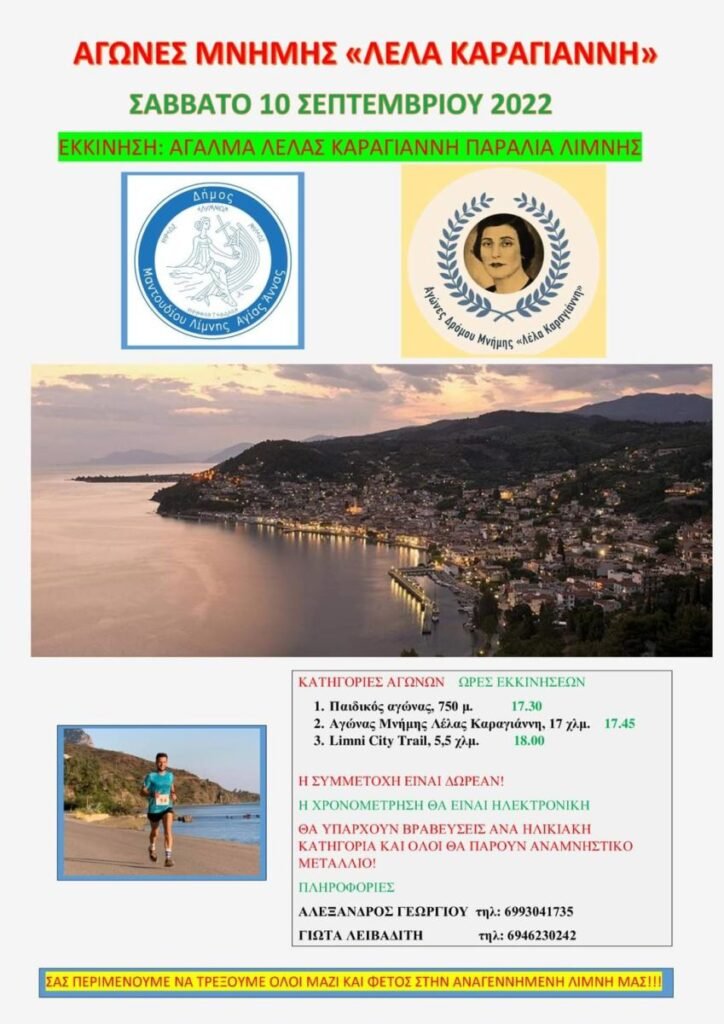
Lela Karagianni (1898–1944), from Limni in Evia, was a heroine of the Greek Resistance. She was arrested by the Germans and executed in September 1944. The station that bears her name is staffed by our friends from Limni, the organisers of the Limni City Trail.
A few words from our friends in Limni
“We were delighted to accept the very kind invitation of our fellow runners of the ‘Dromeis Evias’ club to staff the 4th aid station of the Dirfys Trail Run. These fellow runners and organisers helped us enormously by staffing the 1st and 3rd aid stations of our own race, held in memory of the heroine Lela Karagianni in Limni, a town that has suffered so much from forest fires.
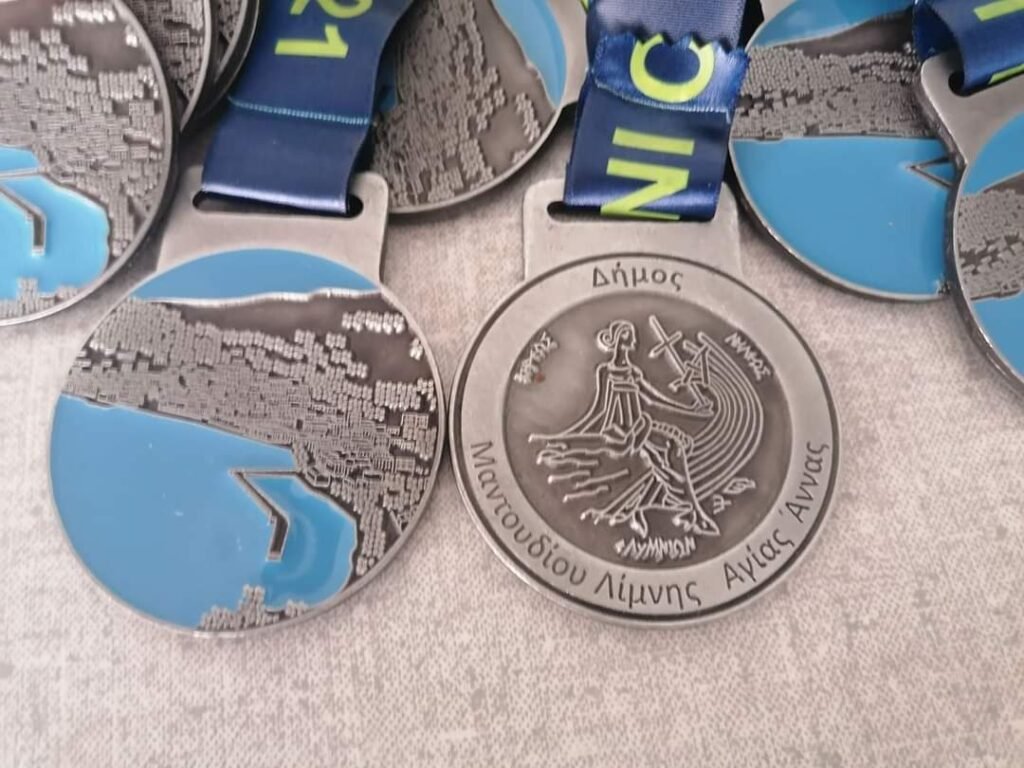
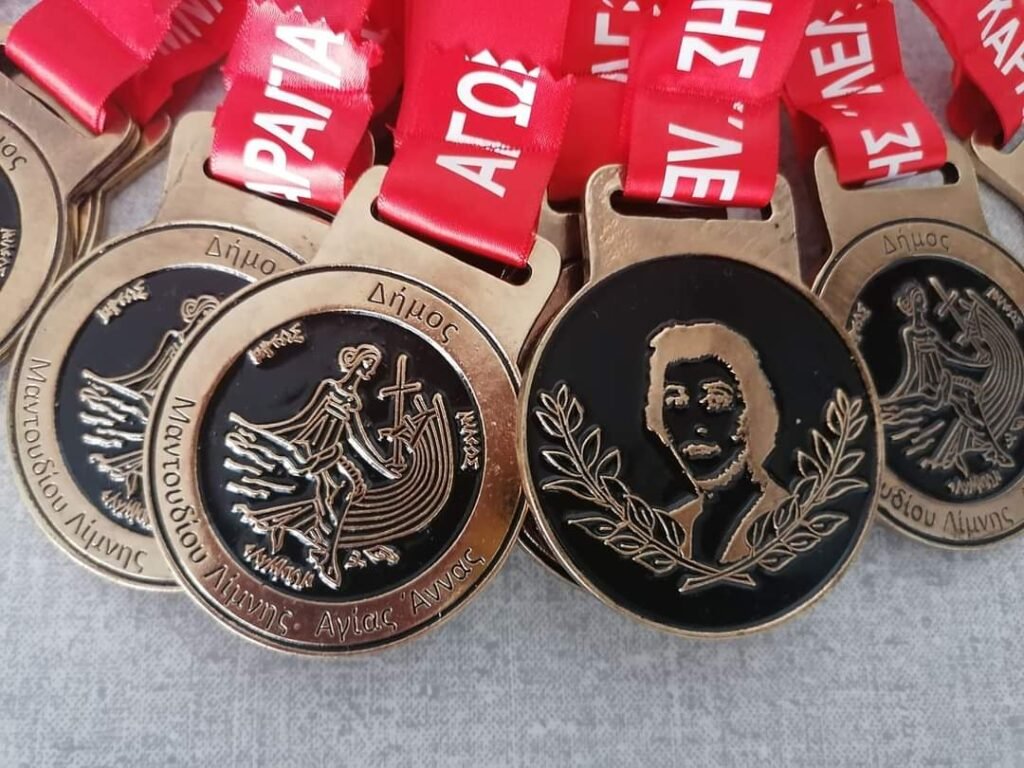
We dedicated our 2nd race, the Limni City Trail, to the effort to bring green life back to our fire-stricken area, as the course passed through the burned neighbourhoods of our town. See you on the green slopes of Dirfys and on the technical trails that our tireless fellow runners and organisers have cared for and cleared with such dedication!!!”